

Home/Guides/Boat and trailer clearance
Guide · new doors · the Belmont question
Will the boat clear the door?
Belmont keeps its boats at home. Between the channel, the ramps and the sailing club, half the garages on the low shore are really boat sheds, and every boat upgrade eventually meets the same doorway. Here's how to answer the clearance question properly, before the new rig is sitting in the driveway.
Measure the rig where it's actually tallest
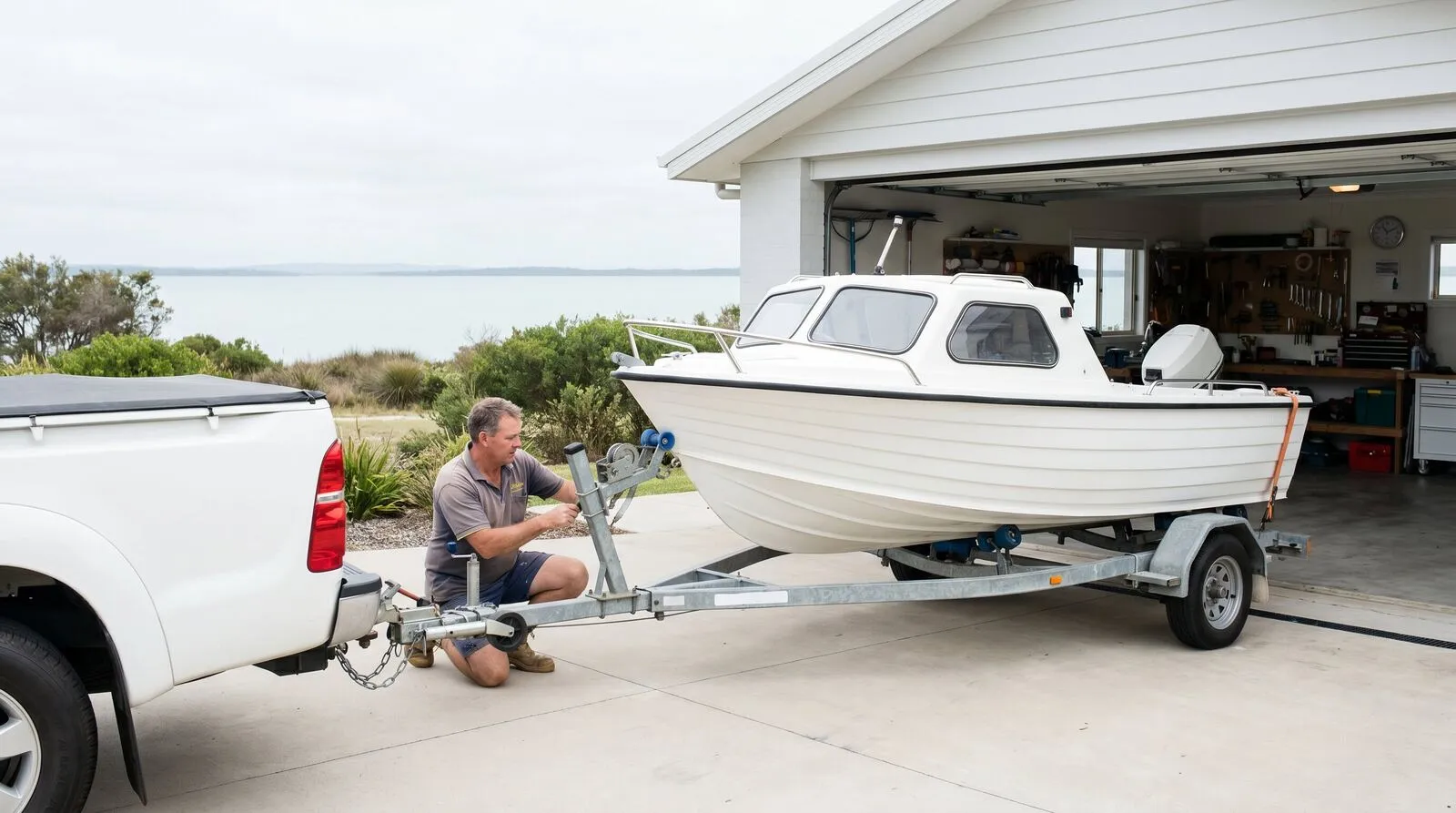
The number that matters is the highest fixed point of the boat on its trailer, hitched and sitting level, because that's how it enters the garage. The true high point is rarely the hull. Work along the rig with a straight edge and a tape, and check the usual suspects:
- Rocket launchers and rod holders standing above the targa or windscreen
- Bimini and canopy frames, even folded ones, and navigation lights on top of them
- Aerials, spotlight brackets and anchor lights (fold or unscrew what folds, then measure what's left)
- An outboard in its travel position, on some rigs it stands proud of the transom
- The bow rail at the winch post end, on a steep-nosed hull it can win
Measure on flat level ground with the trailer hitched to the car, not on the jockey wheel, because nose-down or nose-up attitude changes the answer by real centimetres. Tyres at road pressure. If the driveway slopes up into the garage, the rig effectively grows on the way in; a steep transition can add more than you'd think, so note it for the measure visit.
Measure the opening, not the door
Inside the garage, measure from the floor to the lowest point in the doorway when the door is fully open. On many doors that lowest point is not the lintel: it's the bottom edge of the open door curtain or panel hanging in the opening, or the opener rail. Measure at both sides and the middle; slabs aren't always level, and 20 mm matters here.
A first read on your clearance
When it doesn't clear
A rig that misses by a little is sometimes solved on the rig itself: folding gear down as routine, swapping a fixed aerial for a removable one, or adjusting how the boat sits on its trailer. When the gap is real, the conversation moves to the opening, and there are more options than most people expect:
- A taller door in the existing structure. Sometimes the lintel and slab allow more opening than the current door uses.
- High-lift track on a sectional door. The door travels higher up the wall before curving back, clearing the opening without rebuilding it. Needs wall height above the doorway, which we check at the measure.
- A different door type. A roller door's drum sits above the opening rather than hanging gear in it, which on some garages recovers the centimetres that matter.
- Structural change, honestly named as the biggest job of the list: raising the lintel is builder's work that a door company should be straight with you about, and we are.
Which of those suits your garage isn't something a web page can promise. It's exactly what the free measure visit is for: we put a tape on the opening, look at the wall and the slab, and give you the real options with a real figure against each.
The helper above is general guidance for a first read, not a fit guarantee. Openings, slabs and driveways all have opinions; we confirm everything with a tape on site.